 The Element Within
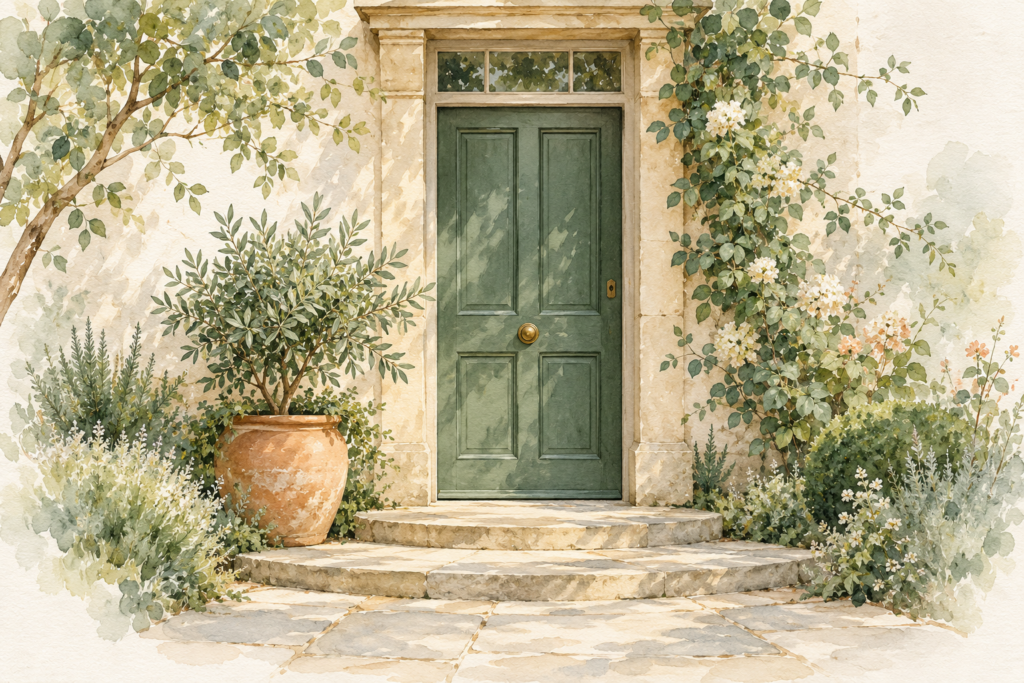
Your front entrance is the first hello your home offers. It is where you arrive, welcome others and move between your private space and the wider world. In Feng Shui, it is often called the Mouth of Qi: a place where the home receives energy and opportunity.
I like to begin with a simple question: how does it feel to come home? A clear path, a door that opens easily and a little care can make that everyday moment feel more welcoming. You do not need a grand entrance to create a thoughtful one.
Create a welcoming entrance
Before thinking about colours or compass directions, look at what is already there. In traditional Feng Shui, clutter and poor maintenance are associated with interrupted flow. There are practical reasons to care for these details too: they help you use the entrance comfortably and see where you are going.
- Clear shoes, unused pots and boxes from the doorway and approach.
- Check that locks, handles, doorbells and hinges work properly.
- Keep the doormat clean and choose lighting that makes the path easy to see.
- Care for plants and remove broken or neglected decorations.
- Allow the door to open freely without furniture or storage getting in the way.
A healthy plant, warm light or a natural texture may be enough. Choose something you enjoy seeing each day, rather than adding objects simply because you feel you should.
Colour and direction
Colour can be a gentle way to bring intention to an entrance. The Five Elements offer traditional associations between directions, materials and colour families. The guide below is a starting point for exploring those relationships.
The direction a door faces is not always the same as the facing direction used to assess the whole property. A full Flying Stars consultation considers more than a single compass reading. If the orientation is unclear, seek guidance before making changes based on it.
| Direction & element | Colour family |
|---|---|
| NorthWater | Black, navy and dark blue |
| SouthFire | Red, burgundy and purple |
| East & southeastWood | Green, teal and wood tones |
| West & northwestMetal | White, grey and metallic tones |
| Northeast & southwestEarth | Beige, sand and soft yellow |
There is no need to choose the brightest version of an element colour. A quiet green, a soft earth tone or a subtle metallic detail may sit more comfortably with the building. Consider the architecture, surrounding colours and any practical requirements for the door as well as the symbolism.
Paths, lighting and surroundings
Traditional Feng Shui pays attention to the way an approach leads towards the home. Curved or gently angled routes are often interpreted as allowing Qi to gather, while a long, direct approach may be seen as moving too quickly. These are ways of reading a space, rather than guarantees about what will happen to its occupants.
Start with changes that make sense for your home. Prune plants that obscure the entrance, keep the route clear and use lighting thoughtfully. If the doorway sits below street level, a well-cared-for approach and visible entrance can help it feel more inviting. Keep access safe and comfortable when considering planters, screens or other additions.
When the front and back doors align
A direct line between front and back doors is sometimes described in Feng Shui as Qi passing through too quickly. It does not mean that financial loss or relationship difficulties are inevitable. Instead, look at how the route feels and how people actually move through it.
A rug, a carefully placed plant or a change in furniture arrangement may soften a long sightline. The aim is to create a comfortable transition without blocking circulation, doors or an exit. The most useful adjustment is one that supports the way you live.
Small changes, made with intention
The entrance should feel in proportion to the home and comfortable to use. An unusually large or small door is not, by itself, a prediction about wealth or wellbeing. Nor does one paint colour promise a particular result. In my work, I consider the whole setting and the people who live there.
Give yourself a moment to notice the entrance after making a change. Does it feel clearer? Is it easier to move through? Do you enjoy arriving home? These simple observations can be a helpful place to begin.
Your next step
If you would like to understand your home in more depth, start a conversation with me. Together, we can explore what your space needs and choose thoughtful changes that feel right for you. You can also explore my consultations to find your starting point.