 The Element Within
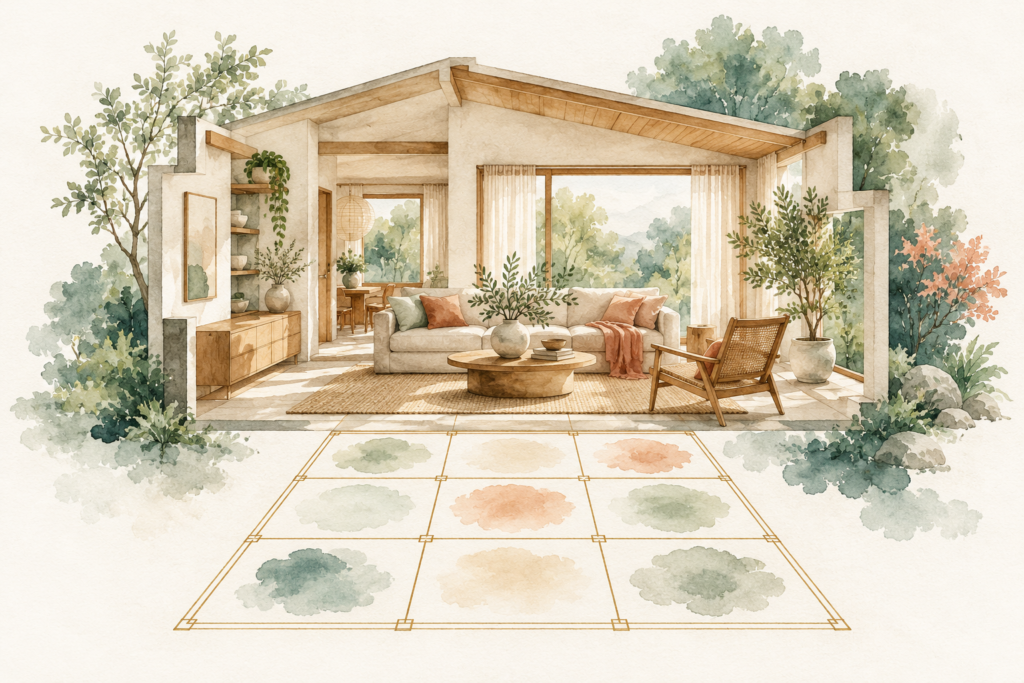
The Ba Gua is one of the most recognisable tools in Feng Shui, yet a simple picture can only tell part of its story. I like to think of it as an invitation to look at your home with fresh attention: how you use each space, what feels supportive and where a little more care may be welcome.
It brings together traditional associations between directions, elements and aspects of life. Used thoughtfully, it can offer a framework for reflection. It does not mean that a room or a missing corner determines what will happen to you.
What is the Ba Gua?
Ba Gua means “eight trigrams”. These eight groups of lines are part of the symbolism of the I Ching, or Book of Changes. In Feng Shui, a related nine-section map places eight sectors around a centre.
The grid below shows compass directions, element associations and commonly used life themes. Those life themes can be useful prompts, but the grid is not the whole of a classical Feng Shui assessment. Different schools use and interpret the Ba Gua in different ways.
- SoutheastWealth & prosperityWood element
- SouthFame & reputationFire element
- SouthwestRelationshipsEarth element
- EastFamilyWood element
- CentreHealth & balanceEarth element
- NortheastKnowledge & self-cultivationEarth element
- NorthCareer & life pathWater element
How the map relates to your home
In compass-based approaches, the directions on the map are aligned with the actual orientation of the space. In entrance-aligned approaches, the map is positioned in relation to the entrance instead. These methods should not be treated as interchangeable.
For the compass-based discussion here, south is displayed at the top of the illustration. That is a diagram convention, not an instruction to turn your floor plan so that the front door always sits at the bottom. The right orientation depends on the method being used and the property itself.
When looking at a home, I consider the map alongside its layout, surroundings and the experience of the people who live there. Useful questions include:
- How are the different rooms used day to day?
- Are there areas that feel neglected, crowded or difficult to use?
- Where is movement comfortable, and where does it become awkward?
- What would make the home feel more supportive of your present needs?
Missing areas and extensions
An irregular floor plan may extend beyond a simple grid or leave part of it unoccupied. Feng Shui practitioners may describe these as extensions or missing areas, but the way they are assessed depends on the school and the shape of the building.
A fixed fraction, such as a one-third rule, should not be treated as a universal test. Nor should a missing sector be read as proof that you will experience a particular health, financial or relationship problem.
I prefer to begin with the whole home and its context. A bay window, an addition or an unusual corner may have a practical purpose and a character of its own. The question is how the space can support you, not whether your home passes a simple good-or-bad test.
The Ba Gua as a tool for self-reflection
Our homes can reflect our habits, priorities and the things we have not yet made time for. A neglected corner may simply need attention. A crowded room may be asking for a clearer purpose. These observations do not require us to assume that the room causes a difficulty elsewhere in life.
You might use the themes in the map to ask yourself:
- Where do I feel supported with ease?
- Which parts of my home help me rest, connect or concentrate?
- What am I holding on to that no longer serves the way I live?
- Which area would benefit from a little more care or clarity?
Choose one manageable change and notice how it feels. Clear a surface, care for a plant or make a space easier to use. There is no need to change every area at once. If clutter is making it difficult to begin, my decluttering and space organising support offers a gentle place to start.
A map is a beginning
The Ba Gua is most useful when it encourages awareness rather than worry. It can help open a conversation about your home, while a personal consultation brings the wider picture into view.
If you would like to explore how your space supports you, discover my Feng Shui consultations or start a conversation with me. Together, we can look for thoughtful changes that bring a greater sense of balance to everyday life.
For further background, the International Feng Shui Guild’s introduction to the Ba Gua discusses its use across different approaches.